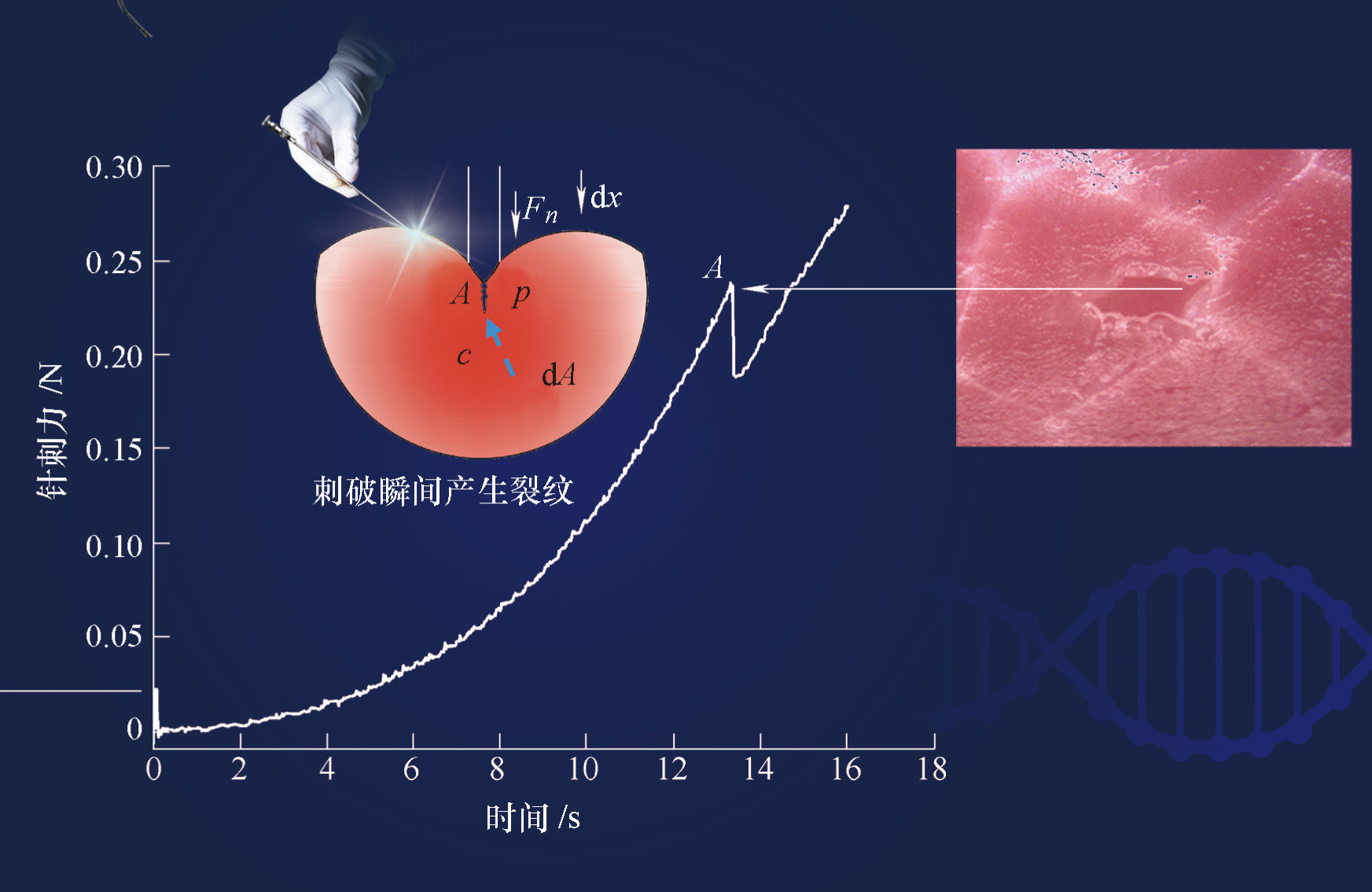
The interactive action between suture needle and liver tissue is investigated by using a biological materials testing machine to simulate the surgical suturing operation. The energy equilibrium equations are established according to the force analysis of the suture needle in the two phases of no tissue break phase and tissue break phase. Based on the energy balance equations and the particular puncture tests, the effects of different insertion velocities, needle cross-section shapes and diameter size on the energy dissipation of crack spread in the liver tissue are studied. The results show that with the increasing insertion velocity, the resistance of needle puncturing its surrounding tissue increases, which results in the energy consumption enhance. However, the puncture force reveals a decrease trend with the increasing insertion velocity. The needles with triangle cross-section tip and larger diameter size show higher resistance against the surrounding tissue, which result in bigger puncture force and more energy consumption in the process of suturing operation.
LI Wei
,
BAO Xiong
,
ZHOU Zhongrong
. Study on Energy Dissipation of Puncture Process by Using Minimally Invasive Surgical Suture Needle[J]. Journal of Mechanical Engineering, 2018
, 54(7)
: 107
-113
.
DOI: 10.3901/JME.2018.07.107
[1] 赵玉沛. 普通外科缝合技术和缝线的发展历史现状和展望[J]. 中国实用外科杂志, 2008(10):789-792. ZHAO Yupei. Development history, current situation and prospect for common surgical suture technology and stitching[J]. Chinese Journal of Practical Surgery, 2008(10):789-792.
[2] 马榕,吕斌. 普通外科缝合技术训练与应用[J]. 中国实用外科杂志, 2008, 28(1):33-34. MA Rong, LÜ Bing. General surgical sutures training and application technique[J]. Chinese Journal of Practical Surgery, 2008, 28(1):33-34.
[3] JACKSON R C, CAVUSOGLU M C. Modeling of needle-tissue interaction forces during surgical suturing[C]//IEEE International Conference on Robotics & Automation. NIH Public Access, 2012:4675-4680.
[4] MOHSEN M, DUPONT P E. Mechanics of dynamic needle insertion into a biological material[J]. IEEE Transactions on Bio-medical Engineering, 2009, 57(4):934-943.
[5] JIANG S, LI P, YU Y, et al. Experimental study of needle-tissue interaction forces:Effect of needle geometries, insertion methods and tissue characteristics[J]. Journal of Biomechanics, 2014, 47(13):3344-3353.
[6] FRICK T B, MARUCCI D D, CARTMILL J A, et al. Resistance forces acting on suture needles[J]. Journal of Biomechanics, 2001, 34(10):1335-1340.
[7] CAPEK L, JACQUET E, DZAN L, et al. The analysis of forces needed for the suturing of elliptical skin wounds[J]. Medical & Biological Engineering, 2012, 50(2):193-198.
[8] JIANG X, ZHANG Y, JIANG J, et al. Characterization of oxygen vacancy associates within hydrogenated TiO2:A positron annihilation study[J]. Journal of Physical Chemistry C, 2012, 116(42):22619-22624.
[9] WANG Y, SPANGLERR C, TAI B L, et al. Positional accuracy and transmitter orientation of the 3D electromagnetic tracking system[J]. Measurement Science & Technology, 2013, 24(24):47-52.
[10] GERWEN D J V, DANKELMAN J, DOBBELSTEEN J J V D. Needle-tissue interaction forces-A survey of experimental data[J]. Medical Engineering & Physics, 2012, 34(6):665-80.
[11] TOUFIC A, VINCENT H. Estimation of the fracture toughness of soft tissue from needle insertion[C]//Biomedical Simulation, International Symposium, Isbms 2008, London, UK, July 7-8, 2008, Proceedings. 2008:166-175.
[12] SHERGOLD O A, FLECK N A, KING T S. The penetration of a soft solid by a liquid jet, with application to the administration of needle-free injection[J]. Journal of Biomechanics, 2006, 39:2593-2602.

